

HAI Score™ Scoring Methodology
The HAI Index is an Independent Standard for Responsible AI measuring how organizations align AI with accountability, governance, and human impact.
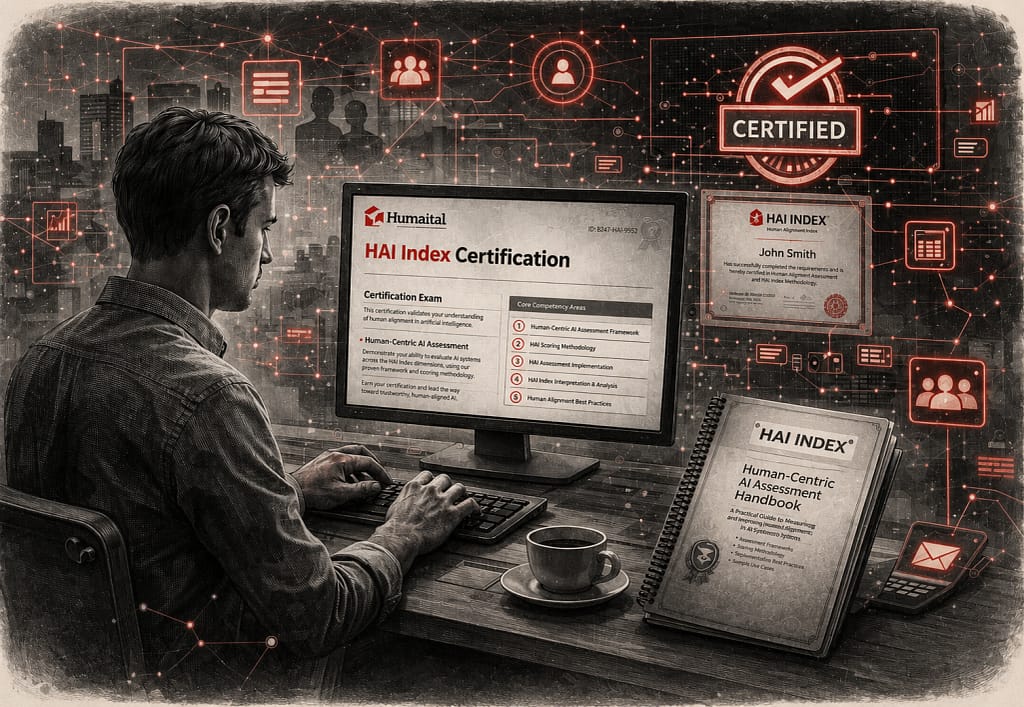
The Human-Alignment Index™ evaluates organizations across six human-centered pillars using a structured, evidence-based rubric. Scores are calculated from publicly observable governance practices, weighted by the quality of evidence available, and adjusted for organizational maturity.
A score of 70 or above earns Certified HAI Company status based on the following criteria:
6 – EVALUATION PILLARS
Trust, Accountability, Purpose, Safety, Transparency, and Impact. Each weighted to reflect its role in responsible AI governance.
20 – ASSESSMENT CRITERIA
Each pillar is evaluated against specific, observable criteria drawn from governance disclosures, public policy documents, and operational evidence.
5 – EVIDENCE TIERS
Evidence quality ranges from published policy statements through to formal third-party audits. Higher-quality evidence earns stronger scores.
70 – CERTIFICATION THRESHOLD
Organizations scoring 70 or above on a 100-point scale achieve Certified HAI Company status, subject to human review confirmation.

How Evidence Is Weighted
Not all evidence is equal. A company that has published a formal AI ethics policy with documented implementation carries more weight than one that has made a general statement of intent. The HAI framework uses five evidence tiers to distinguish between aspiration and demonstrable practice.
POLICY STATEMENT
A published written policy or commitment that addresses the criterion. The organization has stated a position but may not have demonstrated implementation. 1.0 × BASE WEIGHT
PROCESS DOCUMENTATION
Evidence of an operational process — procedures, workflows, or governance mechanisms that indicate the policy is being actively applied, not merely stated. 1.5 × MULTIPLIER
CONTROL EVIDENCE
Documented internal controls, review mechanisms, or oversight structures that enforce the process and ensure ongoing accountability to the stated standard. 2.0 × MULTIPLIER
PERFORMANCE METRICS
Quantitative or qualitative outcome data demonstrating that the controls are producing measurable results, bias audit results, incident response rates, transparency reports. 2.5 × MULTIPLIER
INDEPENDENT AUDIT
A formal assessment by a qualified third party that validates the organization’s governance practices against an established standard. This is the highest available evidence tier and carries the greatest scoring weight. 3.0 × MULTIPLIER
How HAI is Scored
Trust
20 POINTS · HIGHEST WEIGHT
Evaluates whether systems behave consistently, ethically, and without manipulation. Trust is foundational — without it, no other pillar has meaning. The weight reflects that trust is both the hardest to build and the easiest to destroy.
Key Criteria Include: Behavioral consistency, Ethical intent, Anti-manipulation design, Stakeholder reliability
Accountability
15 POINTS
Measures whether organizations accept responsibility for outcomes and take corrective action when harm occurs. Accountability without cost is not accountability — the framework specifically rewards organizations that accept responsibility even when doing so is difficult.
Key Criteria Include: Ownership structures, Remediation practices, Governance controls, Leadership discipline
Purpose
15 POINTS
Measures the clarity and authenticity of an organization’s mission and whether that mission is reflected in real decisions and outcomes. HAI distinguishes between stated intent and demonstrated behavior — purpose without execution does not score well.
Key Criteria Include: Mission clarity, Stated vs. actual behavior, Human benefit prioritization, Leadership alignment
Safety
15 POINTS
Assesses how proactively a company identifies risks, protects users, and considers long-term societal consequences. HAI rewards preventive and forward-looking safety practices — reactive compliance to minimum standards scores at the lower end of this pillar.
Key Criteria Include: Risk identification, User protection, Societal harm anticipation, Adaptive safeguards
Transparency
15 POINTS
Examines how openly a company communicates how its systems work, how decisions are made, and how data is used. HAI rewards clarity over opacity and penalizes disclosures that are technically present but practically inaccessible to stakeholders.
Key Criteria Include: Explain ability, Disclosure practices, Stakeholder communication, User control
Impact
20 POINTS · HIGHEST WEIGHT
Evaluates the real, measurable, and lasting effects of a company’s technology on people, communities, and society. Impact carries the same weight as Trust because ultimately, outcomes are what the framework exists to improve. Intended impact without measured results does not score at the highest level.
Key Criteria Include: Measurable outcomes, Equity and inclusion, Community benefit, Long-term value durability


HAI Index Score: 100 Point
Trust 20/20 Accountability 15/15 Purpose 15/15
Safety 15/15 Transparency 15/15 Impact 20/20
Total Score: 100/100
Certified HAI Company Requires Score of: 70/100

Stage-Adjusted Scoring
Organizational Maturity
A startup deploying its first AI product cannot reasonably be held to the same governance infrastructure standard as a publicly traded company with dedicated ethics staff. HAI accounts for organizational maturity by adjusting scoring thresholds and pillar emphasis relative to what is reasonably achievable at each stage of development. The adjustment reflects context — not a lower standard for human alignment, but a realistic expectation of governance sophistication.
STAGE 1 – Early Stage
Certification threshold: 65 / 100
Seed to early Series A organizations. Emphasis on foundational purpose clarity, basic safety practices, and stated accountability ownership. Formal controls infrastructure is not expected but early design decisions are weighted heavily.
STAGE 2 – Growth Stage
Certification threshold: 70 / 100
Series B through pre-public companies. Governance processes should be documented and operational. Purpose alignment between leadership and execution is evaluated more rigorously. Basic transparency disclosures are expected.
STAGE 3 – Mature / Public
Certification threshold: 70 / 100
Established organizations and public companies. Full governance infrastructure is expected. Impact measurement, third-party validation, and formal accountability structures are required to score at the highest levels of this stage.
What Your Score Means
Score Interpretation
The HAI Score™ is expressed as a number from 0 to 100. The following scale defines how scores should be interpreted at each level. A score is not a verdict — it is a structured view of where an organization currently stands and where it has the most meaningful opportunity to improve.
70–100 – Certified HAI Company
Strong alignment across all six pillars. Governance practices are documented, operational, and producing measurable outcomes. Eligible to display the Certified HAI Company mark.
55–69 – Progressing
Meaningful alignment in place with identifiable gaps. Organization has established foundations but specific pillars — typically Impact or Accountability — require more rigorous evidence or operational depth.
40–59 – Developing
Foundational commitments exist, often at the policy statement level, but governance processes and measurable outcomes are limited. Significant investment in alignment infrastructure is recommended.
0–39 – Emerging
Limited public evidence of alignment governance. Organization may be at an early stage of development or may not have yet formalized human-centered AI practices. Score represents an opportunity baseline, not a judgment of intent.
How an Assessment Is Conducted
Evaluation Process
HAI assessments follow a structured, repeatable process designed to produce consistent and defensible results. Each step is documented internally so that an organization requesting clarification can be shown exactly what was considered.
Evidence Collection
The assessment begins with systematic collection of publicly available organizational information: governance disclosures, published policies, annual reports, regulatory filings, press statements, and any documentation voluntarily submitted by the organization through the HAI verified submission pathway. All sources are logged with retrieval date and URL.
Criterion-Level Evaluation
Each of the 20 criteria is evaluated independently against the collected evidence. The evaluator determines the highest applicable evidence tier for each criterion — from policy statement through to independent audit — and assigns the corresponding score. Criteria with insufficient evidence are flagged explicitly rather than assigned a default score.
Materiality Weighting
Certain criteria carry heightened materiality within their pillar — for example, evidence of active algorithmic harm carries greater weight than the absence of a stated ethics policy. Materiality multipliers are applied at this stage to reflect the relative severity and significance of specific findings within the overall pillar score.
Stage Classification
The organization’s development stage is assessed based on funding history, employee count, public listing status, and operational tenure. The appropriate stage threshold and pillar weight adjustments are applied. Stage classification is documented and visible in the assessment output.
Score Aggregation
Criterion scores are aggregated within each pillar, pillar scores are combined using the defined weights, and the total HAI Score™ is calculated on the 100-point scale. The score is accompanied by a pillar-level breakdown so organizations can identify specific areas of strength and opportunity.
Human Review and Confirmation
All assessments that reach or approach the certification threshold, and any assessment incorporating voluntarily submitted documentation, receive a human review by Humaital’s leadership team before the score is finalized. This review confirms that the AI-assisted evaluation has not mischaracterized evidence and that the overall score reflects a reasonable interpretation of the organization’s governance posture.
The Human Review Layer
Humaital uses AI-assisted analysis to collect and evaluate evidence at scale. However, a named human reviewer — currently Humaital’s founder — is accountable for all certification-level scores and all assessments based on verified submitted documentation. This ensures that the final score reflects considered human judgment, not automated output alone. The identity of the reviewing party is available upon request by any organization whose assessment is under review.
Partial Evaluations
When an organization has restricted access to significant portions of its governance documentation — for example, through authentication-gated policy pages or limited public disclosure — the assessment is flagged as a Partial Evaluation. Partial evaluations are clearly labeled in the assessment output and are not eligible for certification status until complete evidence is available or voluntarily submitted. A partial flag is not a negative finding — it reflects an evidence limitation, not a governance failure.
Conflict of Interest Policy
Independence and Integrity
The credibility of any index depends on the independence of its evaluations. Humaital maintains the following specific boundaries to ensure that commercial relationships do not compromise assessment integrity.
Consulting and advisory relationships. Organizations that have a current paid consulting or advisory engagement with Humaital are not eligible to receive an HAI assessment during the term of that engagement. A minimum 90-day cooling-off period applies after the conclusion of any commercial relationship before an assessment may be initiated.
Partner relationships. Organizations listed as Humaital partners are subject to the same methodology and scoring criteria as all other assessed organizations. Partner status does not influence score outcomes. Partner assessments are subject to mandatory human review regardless of score.
Financial relationships. Humaital does not accept payment from organizations in exchange for a specific score or certification outcome. Assessment fees, where applicable, cover the cost of evaluation and are charged uniformly regardless of result.
Undisclosed interests. Any personal or financial interest held by Humaital personnel in an organization under assessment must be disclosed prior to evaluation. Assessments involving undisclosed interests will be voided and re-evaluated by an independent reviewer.
Score challenges. Organizations that believe a conflict of interest has affected their assessment may submit a formal challenge to Humaital. Challenged assessments are reviewed independently and the outcome is communicated in writing within 30 business days.
Methodology Change Log
Version Control
The HAI Methodology is a living document. Changes are versioned and logged here so that organizations can understand how the methodology has evolved and how any change may affect their score. Prior versions are available upon request.
INITIAL PUBLICATION
First public release of the HAI Score™ Methodology. Establishes six pillars, 20 criteria, five evidence tiers, three maturity stages, and the 70-point certification threshold for mature organizations.
May 2026
This Methodology Document has been reviewed and approved by the ownership, founders, and management of Humaital. It represents the formal, operative standard against which all HAI Score™ assessments are conducted as of the effective date stated above. Any material changes to scoring criteria, evidence weights, or certification thresholds will be published as a new versioned release with a minimum 60-day notice period before taking effect for existing assessments.