
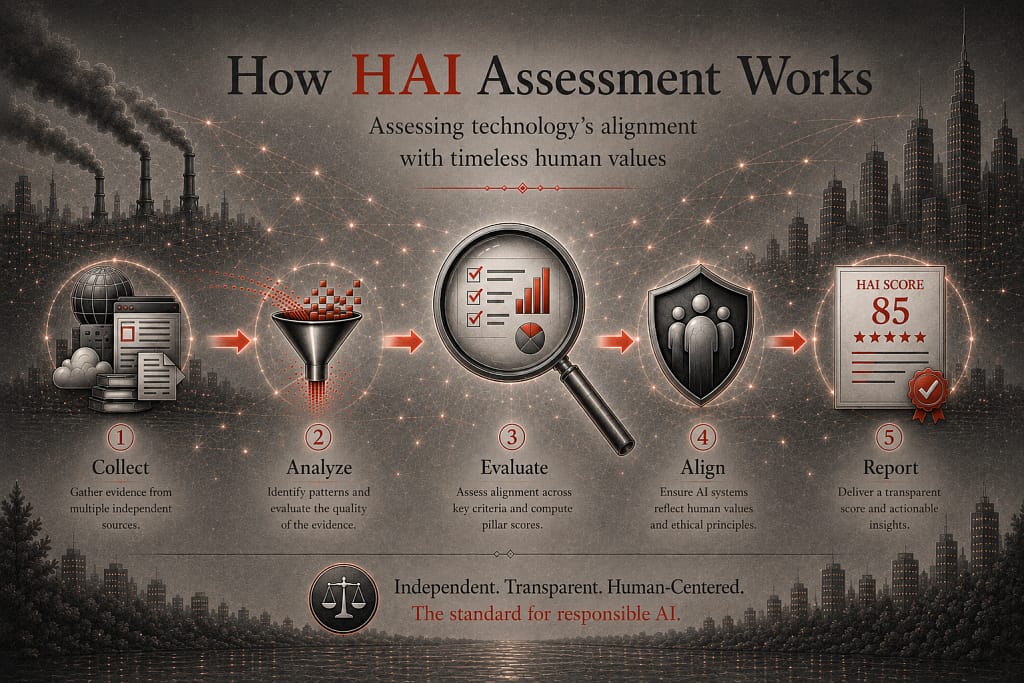
Understanding How Humaital Evaluates AI Governance
Transparency Starts With Us
At Humaital, we believe organizations deploying artificial intelligence should be transparent about how their systems operate, how decisions are made, and where accountability resides.
The Human Alignment Index – HAI Score™ was created to help organizations measure how effectively their AI initiatives align with human values, governance principles, and responsible deployment practices.
Because transparency is one of the six pillars of the Human-Alignment Index™, we believe it is important to explain how our own assessment engine works.
This page outlines what information is analyzed, how assessments are performed, the role artificial intelligence plays in the process, and the limitations that users should understand when interpreting results.
What the HAI Assessment Engine Evaluates
The HAI Assessment Engine evaluates publicly available information to determine how well an organization demonstrates evidence of responsible AI governance.
The assessment is built around six core pillars:
- Trust
- Accountability
- Purpose
- Safety
- Transparency
- Impact
Across these pillars, the system evaluates twenty governance criteria designed to measure both stated commitments and evidence of implementation.
The assessment is evidence-based. Organizations receive credit for publicly demonstrated governance practices, policies, accountability structures, disclosures, and measurable actions.
Information Sources Used During an Assessment
The assessment engine reviews publicly available information that may include:
- Corporate websites
- Governance and policy documentation
- AI principles and responsible AI frameworks
- Sustainability and responsibility reports
- Investor relations materials
- Regulatory filings
- Public disclosures
- Published research
- News and media references
- Publicly available compliance information
The assessment does not require access to confidential, proprietary, or non-public information.
Only information that can be independently reviewed and verified contributes to the assessment.
How Artificial Intelligence Is Used
Artificial intelligence assists the assessment process by helping identify, organize, and analyze large volumes of publicly available information.
The AI system helps:
- Locate relevant governance evidence
- Classify information against HAI criteria
- Identify potential strengths and gaps
- Generate structured assessment summaries
- Produce preliminary scoring recommendations
The AI system does not independently certify organizations and does not make legal, regulatory, investment, or compliance determinations.
The Role of Human Accountability
The Human-Alignment Index is founded on the principle that accountability must remain human.
For that reason:
- Assessment methodologies are defined by Humaital.
- Scoring criteria are established by Humaital.
- Governance standards are maintained by Humaital.
- Certification decisions remain under human oversight.
Artificial intelligence assists the process, but responsibility for the framework and its outcomes remains with Humaital.
Understanding the Confidence Score
Every assessment includes a Confidence Score.
The Confidence Score does not measure whether a company is “good” or “bad.”
Instead, it measures the strength and breadth of publicly available evidence used during the assessment.
Higher confidence scores generally indicate:
- More publicly available documentation
- Greater disclosure transparency
- More independently verifiable sources
- Stronger evidence coverage across the six pillars
Lower confidence scores indicate that limited publicly available evidence was available for evaluation.
A lower confidence score should not automatically be interpreted as poor governance. It may simply indicate limited public disclosure.
Why Scores Can Change Over Time
Organizations evolve.
New policies are published.
Governance structures mature.
Additional evidence becomes available.
For this reason, HAI Scores™ may change over time as organizations update their governance practices or disclose additional information.
Humaital periodically updates its methodology to reflect emerging best practices, evolving regulatory expectations, and advancements in responsible AI governance.
When material methodology updates occur, version changes are documented publicly.
What the Assessment Does Not Measure
The Human-Alignment Index is designed to evaluate publicly observable evidence of governance and alignment practices.
The assessment does not:
- Access private company systems
- Audit internal operations
- Verify proprietary claims
- Provide legal opinions
- Guarantee regulatory compliance
- Predict future organizational behavior
The HAI Score™ should be viewed as an independent governance assessment based on available evidence rather than a certification of perfection.
Our Commitment to Continuous Improvement
Humaital believes accountability begins with accountability to our own standards.
As the field of AI governance continues to evolve, we are committed to continuously improving the Human-Alignment Index™, refining our methodologies, and increasing transparency around how assessments are performed.
Our goal is simple:
To help ensure that artificial intelligence advances in ways that remain aligned with human values, human accountability, and long-term societal benefit.
Questions About Your Assessment?
Organizations that believe an assessment contains inaccurate information or wish to provide additional publicly verifiable evidence may contact Humaital for review at hai@humaital.com.
Assessment feedback helps improve both the accuracy of individual evaluations and the continued evolution of the Human-Alignment Index.
